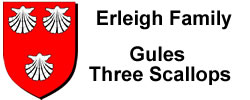
Earl Family DNA Testing
DNA testing can provide valuable information on your ancestry and lineage.
If you have the surname Earl (or some derivative) then you may or MAY NOT be in the “established” lineage of the original de Erleigh family line.
Not all men with the Surname “Earl” stem from the original de erleigh family AND some with different surnames may be from the de erleigh line and not know it.
Haplogroup R1a
Edward Earle YDNA – R1a > L664 > Germanic
The Edward Earle Sr.(abt. 1629-1711) line, who came to America in 1662, is confirmed to be YDNA Haplogroup R1a > L664 > YP1014
Some R1a people accompanied the migration of the R1b tribes. Those R1a men would have belonged to the L664 subclade, the first to split from the Yamna core. These early steppe invaders of R1a and R1b haplogroups were not a homogeneous group, but a cluster of tribes. It is possible that the R1a-L664 people were a separate tribe, or that they mixed with some R1b tribes, notably R1b-U106, which would later become the main Germanic lineage.
Haplogroup R1b
Ralph Earle YDNA – R1b > R-U106 > Germanic
The confirmed Y-DNA line of Ralph Earle, who came to America in 1634, is R1b > R-M269 > R-U106 Germanic branch (S21/U106/M405).
The principal Proto-Germanic branch of the Indo-European family tree is R1b-S21 (a.k.a. U106 or M405). This haplogroup is found at high concentrations in the Netherlands and north-west Germany. It is likely that R1b-S21 lineages expanded in this region through a founder effect during the Unetice period, then penetrated Scandinavia around 1700 BCE (probably alongside R1a-L664), thereby creating a new culture, the Nordic Bronze Age (1700-500 BCE).
These two EARLE lines were both Germanic, not Celtic.
While these lines were not closely biologically related in England (Ralph line R1b and Edward line R1a), they ended up sharing the same surname.
Both lines migrated to England from the same region in about the same timeframe.
Phylogeographic studies indicate the bulk of modern English R-U106 and R-L664 trace migration to England to the 150 BCE–450 CE window (encompassing late Roman and early Migration Period), with Frisian Diaspora effects dispersing these lineages westward into regions like the West Country (e.g., Somerset, Devon).
The fact that both lines shared a common heritage and surname provides evidence for the theory that, before migrating to England, they were both part of the Heruli tribe.
Frisian Migration Connection
The Frisians are a Germanic ethnic group native to the coastal regions of the northern Netherlands (Friesland province), northwestern Germany, and southern Denmark, known for their seafaring traditions and close linguistic ties to Old English (Old Frisian is the nearest relative to Old English among continental Germanic languages).
Genetically, Frisians exhibit high levels of R-U106, reflecting their roots in the proto-Germanic expansions along the North Sea coast.
R-L664 is also present in Frisian/Dutch populations, though at lower frequencies, likely incorporated through early Corded Ware interactions or later Germanic admixture.
Both haplogroups are enriched in this “Anglo-Frisian” zone, linking them to shared North Sea Germanic ancestry.
Studies of ancient DNA from Frisia (e.g., Elp culture burials ~1800–1300 BCE and Migration Period sites ~400–800 CE) show R-U106 dominance, with R1a > L664 in minor proportions, suggesting these lineages co-existed in coastal Dutch/Frisian groups before migrations.